I went hunting last weekend in Botswana with some friends. I managed to get a big wildebeest and this nice impala ram.
I am having him made into salami. Should be tasty.
Keeping you informed on the goings on from Pretoria, South Africa.
Sunday, January 23, 2011
Kgaswana Mountain Reserve
I took the kids camping over the weekend of January 8th at the Kgaswane Mountain Reserve, about an hour and a half drive from our house. We had a very nice time despite a bit of bad weather. We went on a hike in the mountains and saw Eland, zebra and impala. We even had a dip in a beautiful mountain stream. The park also has some amazing quartzite rock formations.
Thursday, January 20, 2011
The Coco de Mer
The Seychelles is home to the largest seed in the world.
It's called the Coco de Mer. In the picture Dillon is holding the fruit of the male tree, and Shea holds the fruit of the female. As you can imagine the distinct shapes of these fruit have been the source of more than a few stories. In the Seychelles the are referred to as the "Love Nut". Thankfully the one Shea is holding is hollow because the female seed can weigh as much a 30 kilos.
They only grow naturally on two small islands in the Seychelles. On the island of Praslin the Vallee de Mai, which is a small national forest of Coco de Mer trees, is now a UNESCO World Heritage site.
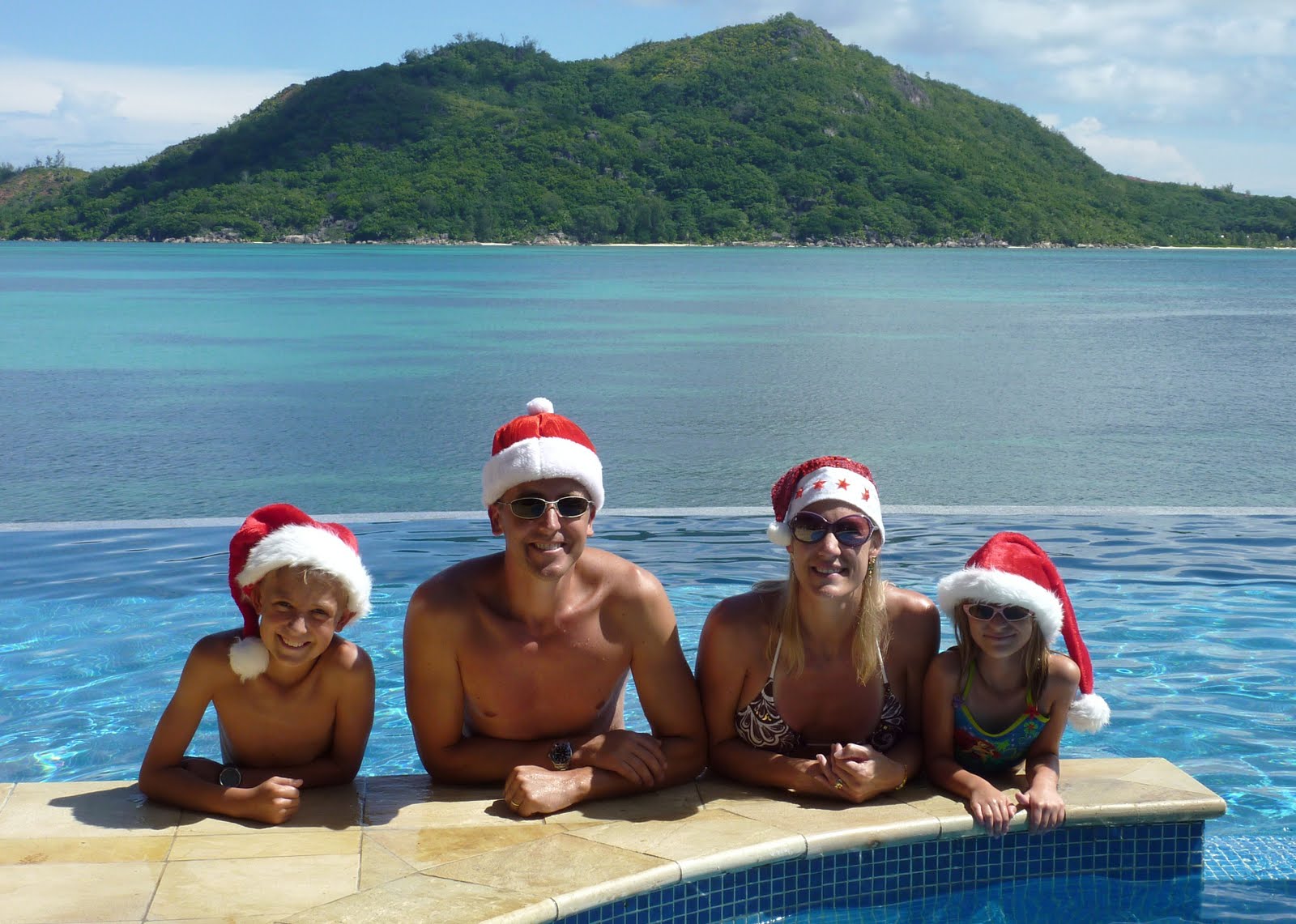
Christmas in the Seychelles
What an incredibly beautiful place. We took the kids fishing, snorkeling and island hopping, but for the most part they just enjoyed playing in the warm ocean waves.
Santa even managed to find us on Christmas.
Pretoria South Africa, our new home
Shortly after Dillon was diagnosed with Type 1 Diabetes, we were told that due to his medical condition we would no longer be able to stay in Botswana. The State Departments regional doctor felt that the health care in Botswana is not adequate enough to deal with Dillon if a problem arose. We were being medically curtailed. This means that Dillon would not be allowed to go back to Botswana for any extended period of time and Cassandra would need to find a new position in another Embassy in a country with good medical care, or we would have to go back to the US.
It was through pure fortune and chance that a position opened up in the HR department at US Embassy Pretoria at this time. Cassandra put in for it and thankfully she was offered the position.
So, in little over a month after Dillon's diagnosis we were living in Pretoria. We have a nice house with a beautiful yard and pool in a quiet neighborhood. The schools are great and the kids are happy. What else could you want?
It was through pure fortune and chance that a position opened up in the HR department at US Embassy Pretoria at this time. Cassandra put in for it and thankfully she was offered the position.
So, in little over a month after Dillon's diagnosis we were living in Pretoria. We have a nice house with a beautiful yard and pool in a quiet neighborhood. The schools are great and the kids are happy. What else could you want?
An Update: Dillon and Diabetes
I think the best place to start would be on August 10, 2010. That is the day we found out that our son Dillon has Type 1 Diabetes. I took him in to see the doctor because he had been wetting his bed on a nightly basis for over a week. This wasn't like him and he seemed helpless to control it. I figured he had a bladder infection and might need some antibiotics. After a quick blood test we were told his blood sugar was literally off the charts and I needed to get him to the hospital immediately.
Up until that moment my knowledge of Diabetes was very limited. I knew that diabetics need insulin and that they have trouble controlling blood sugar. I also knew that there were two different types of Diabetes but I did not know the difference between them. There is no family history of Diabetes in my or Cassandra's immediate family, so it wasn't something we thought much about.
As you can imagine we have learned quite a bit on the subject.
Dillon has Type 1, formerly known as Juvenile Diabetes. People with Type 1 are incapable of producing insulin in their pancreas any more and are completely dependant on insulin injections. At some point, usually after contracting a virus of some sort, the antibodies that are combating the virus for some unknown reason decide to attack the cells in the pancreas that produce insulin. From the moment that process begins you are a diabetic for life. There is no way to stop the antibodies from completely destroying all the insulin producing cells.
With Type 2 diabetes, the most common form which affect 90% of diabetics, their bodies still produce insulin, but the cells are resistant to taking it in. Often, but not always, type 2 is a result of poor diet, lack of exercise, and/or family history. Many type 2 sufferers can manage or reverse the condition without the need for insulin injections. This is not the case with type 1. Without daily injections of insulin type 1 sufferers cannot survive.
Dillon was in the hospital for 3 days in Gaborone until his blood sugar was relatively stabilized. Then he was transferred to a hospital in Pretoria South Africa. He spent another 3 days there, where the main focus was on him learning how to properly manage his diabetes. He learned to do all of his own injections, and take his blood sugar readings. We also learned a lot about carbohydrates and how to deal with low blood sugar problems.
Dillon now tests his blood sugar and gives himself insulin injections a minimum of 4 times per day. He is coping very well and all of this is now become just part of his daily routine.
As you can imagine Cassandra and I were terribly shaken by the knowledge that our son now has a lifelong condition. As a parent you want to protect and alleviate your child's problems, but this was something we had no control over. The best course of action was for us to learn all we could and help Dillon manage his diabetes properly. What has really made it easier for us is the way Dillon has dealt with it. He has shown us a strength of character and resolve we are so proud of. Seeing him deal with his diabetes so well has helped us realize that he will be OK, and that with proper management he will live a long and healthy life.
Friday, July 2, 2010
Warthog...The Other White Meat
I went for a walk in the bush and came upon this warthog grazing in an open meadow. I crept up to within 60 yards, and down she went.
I was about a kilometer away from the road, so it was along haul through the bush to get it out of there.
Tuesday, June 29, 2010
Lions
It has been quite a while since I posted anything on here so I have added a few photos below that give a brief and incomplete summery of some of the happenings around here in the past couple of months. it has been a very busy time for us. I hope to fill in the details at a later date, but for now let's discuss last weekend.
Dillon and I went on a three day camping trip to the Khutse Game Reserve with my friend Matt and his son Jack. Our hopes were to see some lions. As of yet we had not seen any wild lions in our time in Africa. We have been in many areas in which lions are reported to be, but haven't spotted a single one.
Well that all changed last weekend. After a five hour drive we entered an area with a known waterhole, and there they were. A pride of ten lions were sitting around a dead young giraffe that they had killed earlier in the day. Many of them were sitting only a few meters away from the road we were on. What an incredible stroke of luck.
We spent the next three days watching them slowly consume the young giraffe. It wasn't very difficult to keep an eye on them, as the camp site we were assigned was only 300 meters from where they had killed the giraffe. That was a bit nerve racking but at least we knew they weren't hungry. We could hear them at night as we sat around the campfire. I was truly grateful for the rooftop tent.
This is a shot of two of the adolescent lions in the pride.
Cape Town, South Africa
Our first visitors
Wednesday, March 3, 2010
South African Traffic Jam
While we were driving through Pilanesberg we got stuck in a massive traffic jam. The cause of the whole mess was none other than a bull elephant walking down the middle of the road. As it walked up the road all of the cars moved slowly with it. That includes the cars facing head on with the elephant. They all slowly backed down the road as it came their way. This went on for nearly a half an hour until he decided to move off into the bush.
Monday, March 1, 2010
Pilanesberg, South Africa
We went down to Pilanesberg, South Africa last weekend for a short camping trip. Pilanesberg is a big game reserve that is about a 3 hour drive from our home here in Gaborone. They have all of the Big Five in the park. (If you don't know the Big Five, click on the link).
The park surrounds the crater of a long extinct volcano, that last erupted 1.5 Billion years ago. Yes that is Billion with a B. The crater makes a series of concentric rings of hills that radiate out from a central valley.
It is near the end of the wet season here, so the park is dense with long grass and green vegetation. It is very beautiful, but all that greenery makes it difficult to spot anything but the largest animals. Thankfully there are plenty of large animals in the park. We saw more than 20 elephants. Some at pretty close range. The park is abundant in Giraffe as well. We lost count of how many of those we spotted. In fact at one point, as I was driving around a tight curve in the road I had to jam on the brakes to avoid rear ending a giraffe that was standing in the road. We also saw loads of wildebeest, Impala, warthogs, zebra and a few white rhino. The bird life in Pilanesberg is also incredible. I usually stick to the mammals in my game viewing, but you can't help but notice the beautiful colored birds throughout the park.
Where we were camped was a bit of a zoo. There was little or no privacy while camping in the Manyane campground. It was more densely packed than a KOA on 4th of July weekend. It was nicely kept though. It was clean, with nice facilities including a small store, a swimming pool, playground, gift shop and a restaurant. We ate at the restaurant the night before we left and had an interesting meal. I had the Eland steak, and Cassandra had the Kudu. Impala chops were also on the menu, but will have to wait till next time.
Still with all those people around you had to watch out for thieving baboons. We saw baboons running throughout the campground stealing food and generally causing havoc.
We will be going back to Pilanesberg in April when my Mom and Bill Arrive for a visit. We will be staying in the nice chalets they have on sight, so we should have a bit more comfortable stay.
Saturday, January 23, 2010
Botswana: What's it Like?
Driving outside of the city limits can be challenging, and at night it is down right dangerous. One of the reasons for this is the large number of donkeys running loose. The Batswana use them to pull wagons like you can see here. In rural areas this is one of the main forms of transportation. When the donkeys are not pulling a wagon, they can usually be found grazing on the side of the road. If you hit one of these with your car it's not going to be pretty.
Tuesday, January 19, 2010
Tuli Block: Part II
On our last full day, we decided to take it easy, and only go on some short game drives. Of course once we got on the road, I just kept going until we ended up being in the car most of the day again. We did travel at a leisurely pace, and spent time enjoying the scenery and watching the wildlife. We saw zebra, kudu, warthogs, lots of impala, and even a group of giraffe's. We passed a huge ostrich farm, with thousands of ostriches. We did not see any elephants though, and that was one of our main reasons for going to this area. Oh well, we will get our chance eventually.
We took our time packing up in the morning, and got on the road about 9am. It was a hot day, but it seemed unusually hot in the car. We had the A/C on full blast, but it didn't seem to be cooling us off at all.
About half way home a bad smell was coming from the back of the vehicle, and I thought it was a leaky butane container that we used with our lantern. I threw it out, but the smell continued . When we got home we realized that the smell was coming from the melted carpeting of the vehicle. Because the tail pipe fell off, the heat from the engine was concentrated directly over the cargo bay, were the camping gear was stored. It was hot enough that it melted the carpet and a blue tarp I had laid down to set the dirty camping gear on. Thankfully everything else was fine.
Now to get the tailpipe fixed, and start planning the next camping trip.
Monday, January 11, 2010
Tuli Block: part I
We spent 3 nights camping in an area in eastern Botswana called the Tuli Block. It consists of a series of private game reserves on the edge of the Limpopo river. It's about a 6 hour drive from home on some very good roads. The roads were paved all the way to within the last 30 kms. We stayed at a very well kept camp site run by the Limpopo River Lodge, right on the banks of the river. In this area the river acts as a border between South Africa and Botswana, so as we sat at our campsite and looked across the river we were looking at South Africa.
We arrived on Tuesday afternoon and set up camp and relaxed after a long drive. As night falls all of the animals come out, and the sounds of living creatures splashing about in the water can be a little creepy. Hippo's and crocodiles live in the Limpopo, but I didn't see any. Cassandra swears we one of the creatures lurking about in the dark was a hippo, but I am sceptical.
Wednesday turned out to be a bit frustrating. We realized we were going need more fuel if we were going to be doing much in the way of game drives. The closest gas station on the Botswana side of the river was about 90 kms away. There was a station closer (about 40 kms away on the South African side), but we would have to go through immigration paper work and things at the border station if we went that way, so we decided to go to the farther station. After driving for about an hour and a half we finally made it to the town with the gas station only to be told they were out of fuel. The next closest station was another 60kms away. We had about a third of a tank left, so I decided we would cross the South African border and get gas since we knew that there was more than one station in that town and when we filled up we would only be 40 kms away from camp instead of 150kms. We drove back crossed the river, went through the border check point (thank goodness Cassandra had all our paperwork), and made it to the gas station just as the fuel light came on. We had spent almost 6 hours of our day driving around dealing with this. The moral of this story is to always carry a supply of fuel with you when traveling outside the city. You can guarantee that I will from now on.
On a side note; when we got back to camp I realized that all the rough road driving had jarred the tail pipe loose from the muffler, the ramifications of which we would not see until the drive back home.
Wednesday, December 30, 2009
Botswana: What's it Like?
Cattle farming is a major part of life for many Batswana. Most people that can afford them, have cattle. In rural areas even those that can't afford cattle will have goats, and donkeys. These animals often wander in and around the roads, so it is very dangerous to drive at night. Even during the day you must really be on your toes and focused while driving. This is the reason many of the vehicles here have huge front bumpers.
This big bull stood right in the middle of the road despite my honking and waving for about 5 minutes.
Tuesday, December 29, 2009
Botswana: What's it Like?
After reviewing this blog, I realized I haven't shown much of what Botswana really looks like. I thought I should start a series of postings that might give you a better impression of what it is really like here.
I decided to start with this picture of the Ministry of Health. This building is one of the tallest, newest, and most modern buildings in Botswana. AIDS and Tuberculosis are major problems in Botswana, and large amounts of money are poured into trying to control these issues. Some reports claim that 37.5 percent of people aged 15 to 50 years old have HIV/AIDS, and that in the coming year as many as 20 percent of Botswana's children could be orphaned because of the disease. Statistics like these damage Botswana's infrastructure at every level.
I also included this picture because this building is only a couple hundred yards from our house, and we see it every day.
Friday, December 25, 2009
Merry Christmas
Subscribe to:
Posts (Atom)